Last updated: 19 October 2026 · By Analyst, Platizio Global
India has no leveraged or inverse exchange-traded funds (ETFs); SEBI’s 100% cap on a fund’s gross exposure rules out 2x and 3x funds. US-listed ones such as TQQQ (3x the Nasdaq-100), SQQQ (−3x) and SOXL (3x a semiconductor index) exist. Whether residents may buy them under the Liberalised Remittance Scheme (LRS) is unsettled: RBI bars derivatives from overseas portfolio investment but has not said whether these funds’ units count.
Key takeaways
- Platforms differ: INDmoney lists TQQQ; Zerodha excludes leveraged ETFs.
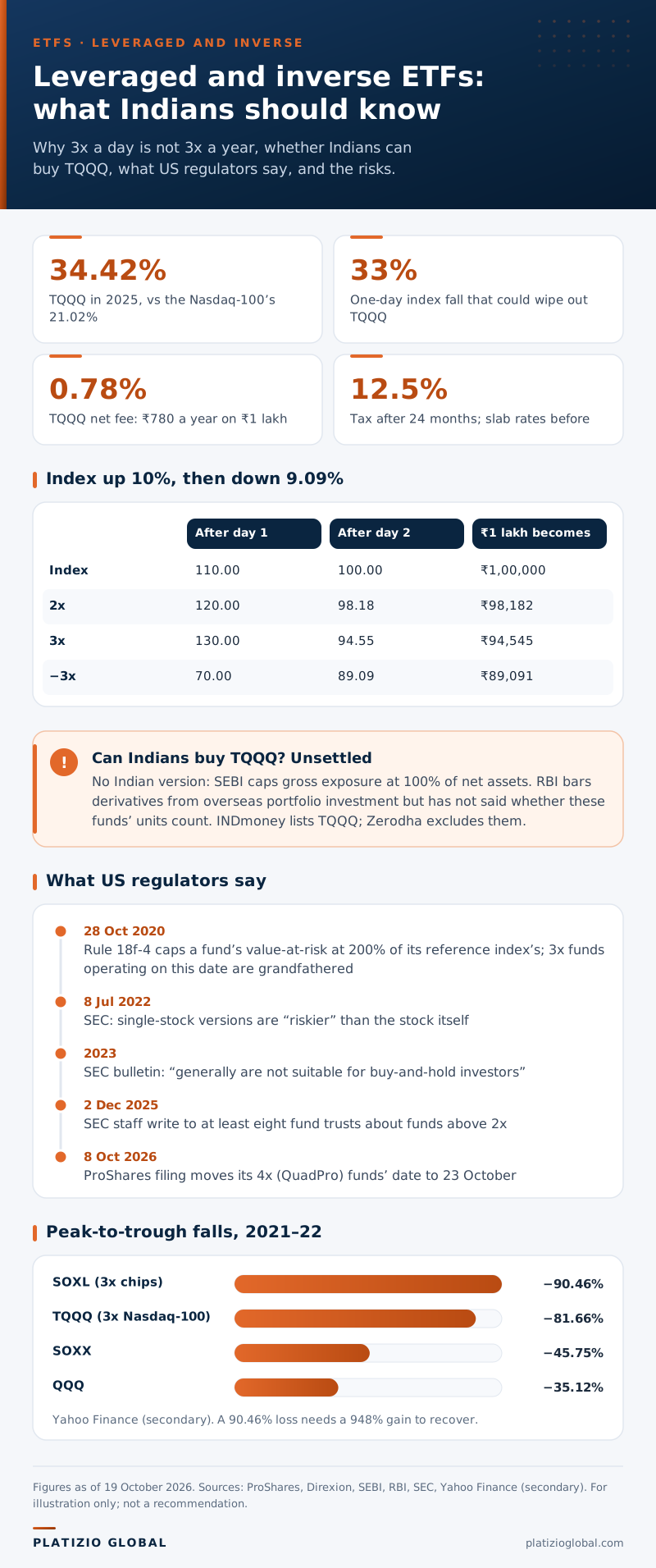
- TQQQ returned 34.42% in 2025, not three times the Nasdaq-100’s 21.02%.
- A one-day index fall approaching 33% could wipe out a TQQQ investment.
- Gains within 24 months are taxed at slab rates; even short trades go in Schedule FA.
How leveraged and inverse ETFs work
These funds target a multiple, or inverse, of one day’s index return. TQQQ seeks “three times (3x) the daily performance of the Nasdaq-100® Index”, not 3x “for any period other than a day”; SQQQ seeks −3x.
Leverage comes mainly from swaps and futures, not borrowing: on 16 October 2026 TQQQ’s swaps with 10 banks equalled about 248% of its US$34.01 billion net assets. Exposure resets at each day’s 4:00 pm New York net asset value (NAV), 1:30 am IST (2:30 am from 2 November).
Leveraged ETF decay: why 3x for a day is not 3x for a year
Over longer periods, swings hurt and strong trends help. TQQQ’s prospectus warns: “you may lose money when the Index rises”. Suppose an index gains 10%, then falls 9.09% back to its start:
| Fund | After day 1 | After day 2 | ₹1 lakh becomes |
|---|---|---|---|
| Index | 110.00 | 100.00 | ₹1,00,000 |
| 2x | 120.00 | 98.18 | ₹98,182 |
| 3x | 130.00 | 94.55 | ₹94,545 |
| −3x | 70.00 | 89.09 | ₹89,091 |
A choppy week ending flat (+5%, −5%, +5%, −5%, then +0.502% back to the start) costs a 3x fund 3.01%. Real results:
| Period | Nasdaq-100 | 3x the index | Fund (NAV) |
|---|---|---|---|
| 2025 | +21.02% | +63.06% | TQQQ +34.42% |
| Q2 2026 (strong rise) | +27.74% | +83.22% | TQQQ +94.78% |
| Q3 2026 | +0.44% | +1.31% | TQQQ −3.75%; SQQQ −3.63% |
ProShares data, except the Q3 index figure: a Yahoo Finance price return (secondary, 19 October 2026).
Major US leveraged and inverse ETFs
| Ticker | Daily target | Net (gross) expense ratio | 2025 vs underlying |
|---|---|---|---|
| TQQQ | 3x Nasdaq-100 | 0.78% (0.94%) | +34.42% vs +21.02% |
| SQQQ | −3x Nasdaq-100 | 0.94% | −53.07% vs +21.02% |
| SOXL | 3x NYSE Semiconductor Index | 0.75% (0.91%) | +55.05% vs +41.22% |
| TSLL | 2x Tesla | 0.83% (0.95%) | −26.87% vs +11.36% |
Issuer prospectuses (ProShares, 28 September 2026; Direxion, 27 February 2026); net ratios include waivers to September 2027. For illustration only; not a recommendation.
Can Indians buy TQQQ or SOXL?
No Indian version. SEBI’s Master Circular (20 March 2026, para 13.18.1) caps cumulative gross exposure at “100% of the net assets of the scheme”, and even Specialised Investment Funds are limited to unhedged short exposure of 25% of net assets. The only US-listed leveraged India fund we found, INDL, is 2x MSCI India, not 3x Nifty.
The LRS rule is silent. RBI’s Overseas Investment Directions, 2022 (para 1(ix)) say overseas portfolio investment (OPI) “shall not be made in… any derivatives unless otherwise permitted by Reserve Bank”, yet count units of a “duly regulated” overseas fund as OPI. RBI has not said which covers a TQQQ unit (a fund unit with mostly swap exposure), so the question is unsettled.
Platforms differ. On 19 October 2026, INDmoney’s TQQQ page said “Yes, Indians can invest”; Zerodha’s guide said “leveraged ETFs are not available”. See how LRS works.
What US regulators say
- SEC: these are “specialized products that generally are not suitable for buy-and-hold investors” (2023 bulletin); single-stock versions are “riskier” than the stock itself (8 July 2022).
- Above 2x: Rule 18f-4 caps a fund’s value-at-risk at 200% of its reference index’s, grandfathering 3x funds operating on 28 October 2020. On 2 December 2025 SEC staff wrote to at least eight fund trusts about funds above 2x, asking ProShares to “revise… or withdraw its filings”. Its 4x (QuadPro) funds were still pending on 19 October 2026; an 8 October filing moved their date to 23 October.
Costs and tax in India
- Costs: TQQQ’s 0.78% is ₹780 a year on ₹1 lakh (unleveraged QQQ: ₹180), before financing: by our estimate from Yahoo Finance prices, a cost-free daily 3x QQQ strategy made about 50% in 2025, TQQQ 34.4%. A round trip at an illustrative 0.29% brokerage (plus 18% IGST on it) and the GIFT City regulator’s 0.005% fee each way costs about 0.7%, before the bank’s markup.
- Tax collected at source (TCS): nil up to ₹10 lakh a financial year, then 20% of the excess as banks apply section 394 of the Income-tax Act, 2025; credited against tax.
- Tax: slab rates on gains within 24 months, then 12.5% (section 197) plus surcharge and cess; distributions at slab rates, with credit up to the Indian tax for the 25% US withholding (treaty rate, with Form W-8BEN). Short-term losses offset any capital gain and carry forward eight years if you file on time (tax on US stocks).
- Unsettled: old section 50AA makes gains on funds over 65% in debt and money-market instruments short-term at any holding period; whether it, or its 2025-Act successor, covers SQQQ (only Treasury bills and a money-market ETF besides derivatives) is for a chartered accountant.
- Reporting: every holding in the calendar year goes in Schedule FA, the return’s foreign-assets list; US estate tax of up to 40% can apply above US$60,000 of US assets.
Who are leveraged ETFs designed for?
Direxion says SOXL is “designed to be utilized only by knowledgeable investors… willing to monitor their portfolios frequently”. TQQQ’s prospectus warns: if the index “approaches a 33% loss at any point in the day, you could lose your entire investment”. Peak to trough in 2021–22 (Yahoo Finance, secondary), TQQQ fell 81.66% (QQQ: 35.12%) and SOXL 90.46% (SOXX: 45.75%); a 90.46% loss needs a 948% gain to recover. Unleveraged routes: Nasdaq-100 guide, semiconductor ETF guide.
Sources
- SEBI: Master Circular for Mutual Funds (20 March 2026), paras 13.18.1 and 21.6.1 — https://www.sebi.gov.in/legal/master-circulars/mar-2026/master-circular-for-mutual-funds_100491.html
- RBI: Master Direction – Foreign Exchange Management (Overseas Investment) Directions, 2022, Part I para 1(ix)(a) and (e) — https://www.rbi.org.in/Scripts/BS_ViewMasDirections.aspx?id=12381
- ProShares: UltraPro QQQ (TQQQ) summary prospectus (28 September 2026) — https://www.proshares.com/globalassets/proshares/prospectuses/tqqq_summary_prospectus.pdf
- ProShares: TQQQ fund page (holdings and NAV at 16 October 2026; returns to 30 September 2026) — https://www.proshares.com/our-etfs/leveraged-and-inverse/tqqq
- ProShares: SQQQ fund page (holdings and NAV at 16 October 2026; returns to 30 September 2026) — https://www.proshares.com/our-etfs/leveraged-and-inverse/sqqq
- Direxion: Daily Semiconductor Bull 3X ETF (SOXL) summary prospectus (SEC EDGAR 497K, 27 February 2026) — https://www.sec.gov/Archives/edgar/data/1424958/000119312526078540/d50601d497k.htm
- SEC Office of Investor Education and Advocacy: Updated Investor Bulletin: Leveraged and Inverse ETFs (29 August 2023) — https://www.investor.gov/introduction-investing/general-resources/news-alerts/alerts-bulletins/investor-alerts/sec
- SEC Office of Investor Education and Advocacy: Statement on Single-Stock Levered and/or Inverse ETFs (8 July 2022) — https://www.investor.gov/statement-single-stock
- SEC Division of Investment Management: letter to ProShares Trust on Rule 18f-4 (2 December 2025) — https://www.sec.gov/Archives/edgar/data/1174610/000000000025011180/filename2.txt
- ProShares Trust: Form 485BXT filed 8 October 2026 (SEC EDGAR) — https://www.sec.gov/Archives/edgar/data/1174610/000117461026001088/f46374d1.htm
- INDmoney: ProShares UltraPro QQQ (TQQQ) page (provider’s own page, checked 19 October 2026) — https://www.indmoney.com/us-stocks/etfs/tqqq
- Zerodha: Global investing guide (provider’s own page, checked 19 October 2026) — https://support.zerodha.com/category/trading-and-markets/general-kite/global-investing/articles/global-investing-guide
Platizio Global is operated by Platizio Services LLP, an AMFI-registered mutual fund distributor. Accounts are opened and held with ViewTrade International IFSC Private Limited, which is regulated by the International Financial Services Centres Authority in GIFT City. Platizio is a referral partner, not a broker, investment adviser or research analyst, and may receive remuneration from ViewTrade. This article is for education only. It is not investment, tax or legal advice, or a recommendation to buy, sell or hold any security. The securities quoted are for illustration only and are not recommendatory. Investments in US stocks and ETFs are subject to market risk, currency risk and tax implications; leveraged and inverse ETFs can lose most or all of their value quickly; past performance is not indicative of future results, and returns are not guaranteed. Prices, fees, tax rates and rules are as of 19 October 2026 and can change; check them with a chartered accountant before you act.