Last updated: 15 October 2026 · By Analyst, Platizio Global
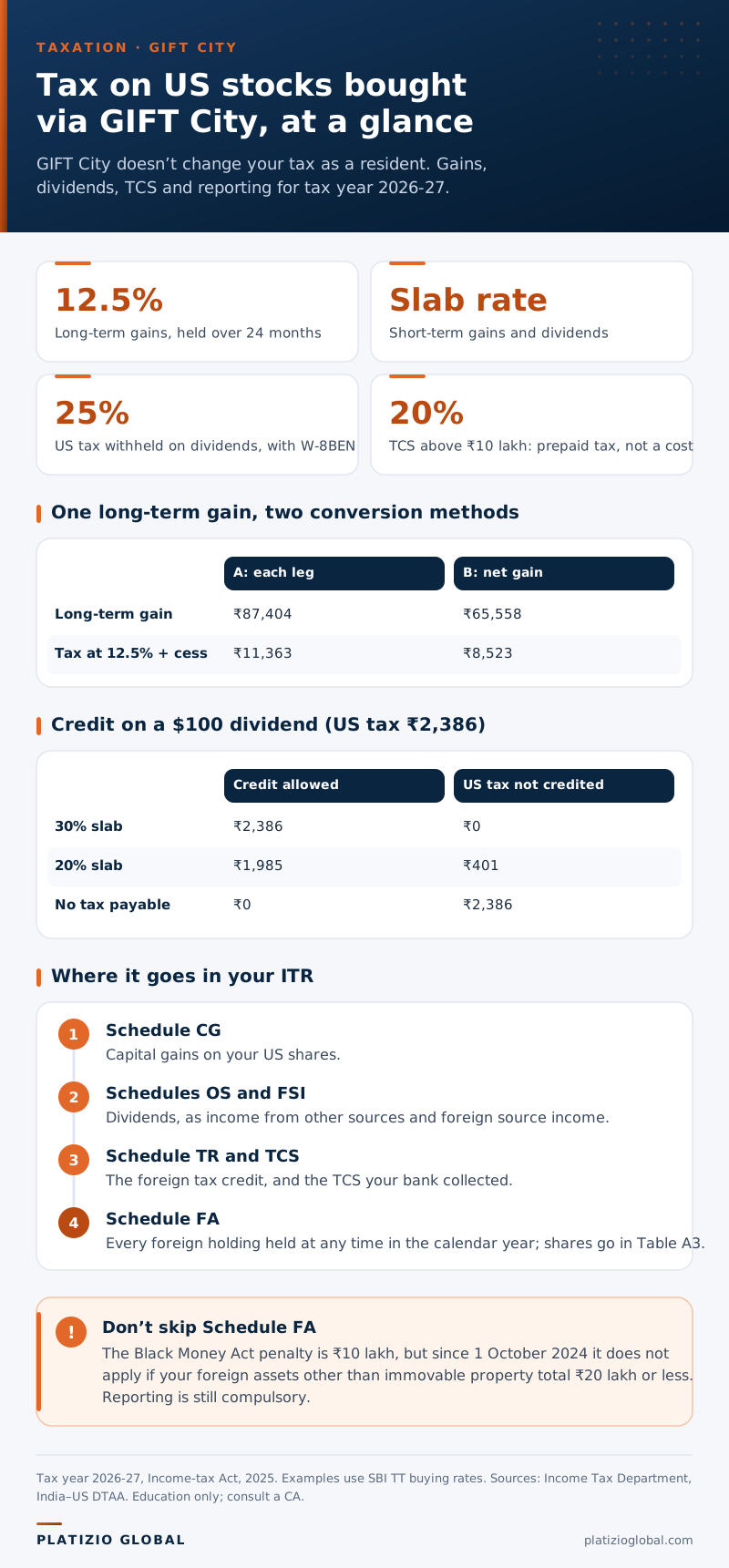
Buying US stocks through GIFT City does not change your tax as an Indian resident. For tax year 2026-27, gains on shares held over 24 months are taxed at 12.5%, shorter-term gains at your slab rate, and dividends at your slab rate with credit for US tax withheld. You must also report the shares in your return every year.
Key takeaways
- Long-term gains (over 24 months) are taxed at 12.5% under section 197 of the Income-tax Act, 2025, without indexation or the ₹1.25 lakh exemption.
- US tax withheld on dividends is credited through Form 67 for FY 2025-26 income and Form 44 from tax year 2026-27.
- Tax collected at source (TCS) of 20% on investment remittances above ₹10 lakh in a financial year is prepaid tax, not a cost.
- The ₹10 lakh Black Money Act non-disclosure penalty does not apply if your foreign assets other than immovable property total ₹20 lakh or less.
Does GIFT City change the tax on US stocks?
No. Tax on US stocks in India follows your residence: a resident’s total income includes income from any source, in India or abroad (section 5(1)). Global Access platforms in GIFT City, India’s International Financial Services Centre (IFSC), buy US-listed shares on US exchanges for you, so you hold foreign shares. Platizio Global (Platizio Services LLP), for example, offers US stocks and ETFs through ViewTrade International IFSC Private Limited.
NSE IX depository receipts are different: they have taken no new buys since 30 July 2026 and close on 1 February 2027 (sell by 29 January 2027 or convert by 20 January 2027). Whether they turn long-term after 12 or 24 months, and whether conversion is a taxable transfer, is unsettled; 24 months is the more conservative filing position.
Capital gains tax on US stocks in tax year 2026-27
Tax year 2026-27 runs from 1 April 2026 to 31 March 2027 under the Income-tax Act, 2025.
| Holding period | Gain | Tax rate |
|---|---|---|
| 24 months or less | Short-term | Your slab rate |
| More than 24 months | Long-term | 12.5%, without indexation (section 197) |
US shares are not listed on a recognised Indian exchange, so the 12-month rule for Indian-listed shares does not apply (section 2(101)), and the ₹1.25 lakh exemption is unavailable because section 198 (old 112A) needs securities transaction tax (STT). Add 4% cess on tax plus surcharge; surcharge starts above ₹50 lakh of income and is capped at 15% on long-term gains and dividends.
Short-term capital losses can be set off against any capital gain, long-term losses only against long-term gains, and unused losses carry forward for eight tax years if you file on time (sections 108, 111 and 121).
How to convert gains into rupees
Rule 206 of the Income-tax Rules, 2026 (old Rule 115) uses the State Bank of India (SBI) telegraphic transfer (TT) buying rate on the last day of the month before the month of sale. It does not say whether to convert the net dollar gain or the cost and proceeds separately. The results differ when the rupee moves, so agree one method with your chartered accountant.
Assumptions: SBI’s TT buying rates on the dates shown, the new regime, income below ₹50 lakh, 4% cess, and 0.25% brokerage plus 18% GST and fees per trade; rupee amounts rounded at each step.
Long-term gain. You buy 10 shares at US$180 on 12 August 2024 (cost with charges $1,805.40) and sell at $250 on 14 October 2026 (proceeds after charges $2,492.45), 26 months later.
| Step | Method A: convert each leg | Method B: convert the net gain |
|---|---|---|
| Cost | $1,805.40 × ₹83.32 (31 July 2024) = ₹1,50,426 | — |
| Sale proceeds | $2,492.45 × ₹95.42 (30 September 2026) = ₹2,37,830 | — |
| Long-term gain | ₹87,404 | $687.05 × ₹95.42 = ₹65,558 |
| Tax at 12.5% plus cess | ₹11,363 | ₹8,523 |
The ₹2,840 gap is tax on the rupee’s fall while you held the shares.
Short-term gain. You buy 5 shares at $400 on 20 January 2026 (cost with charges $2,006.00) and sell at $460 on 10 September 2026 (proceeds after charges $2,293.05). Method A, using ₹89.47 (31 December 2025) and ₹94.90 (31 August 2026), gives a gain of ₹38,133 and tax with cess of ₹11,897 at the 30% slab. Method B gives $287.05 × ₹94.90 = ₹27,241, with tax of ₹8,499.
How are US dividends taxed in India?
Dividends are taxed at your slab rate on the gross amount. The US withholds 25% under the India–US tax treaty if you have filed Form W-8BEN, which claims treaty benefits (30% otherwise; the form lapses at the end of the third calendar year after signing). You can claim credit under section 159 (old 90) up to the Indian tax on the dividend, at no more than the treaty rate.
The claim form depends on the year, and your return must be filed on time or as a belated return (Form 67 guide):
- FY 2025-26 income: Form 67 under Rule 128, due by 31 March 2027.
- Tax year 2026-27 onwards: Form 44 under Rule 76, due within 12 months of the tax year’s end (31 March 2028 for 2026-27). An accountant must verify it if your foreign tax for the year is ₹1 lakh or more. “Form 67” now names an unrelated form.
Example. A $100 dividend paid in October 2026 with $25 withheld, converted at ₹95.42 (30 September 2026), is ₹9,542 of income and ₹2,386 of US tax, claimed on Form 44 by 31 March 2028.
| Your slab | Indian tax with 4% cess | Credit allowed | Extra tax in India | US tax not credited |
|---|---|---|---|---|
| 30% | ₹2,977 | ₹2,386 | ₹591 | ₹0 |
| 20% | ₹1,985 | ₹1,985 | ₹0 | ₹401 |
| No tax payable | ₹0 | ₹0 | ₹0 | ₹2,386 |
TCS on LRS remittances is a credit, not a cost
Money sent to a GIFT City account is a remittance under the RBI’s Liberalised Remittance Scheme (LRS). Once your LRS remittances in a financial year, across all banks, exceed ₹10 lakh, your bank collects 20% of the excess on investment remittances as TCS (section 394, old 206C(1G)), with no exemption for GIFT City. A first remittance of ₹15 lakh in financial year 2026-27 attracts 20% × ₹5 lakh = ₹1,00,000. TCS shows in Form 168 (earlier Form 26AS) and is claimed in your return, with any excess refunded; salaried investors can also give their employer Form 122 so less tax is deducted from salary.
How to report US stocks in your ITR
- Schedules: gains in Schedule CG; dividends in Schedules OS and FSI (foreign source income); the foreign tax credit in Schedule TR; TCS in Schedule TCS.
- Schedule FA (foreign assets): list every foreign holding held at any time in the calendar year; shares go in Table A3, and ask your platform how to report the GIFT City account itself.
- Due dates: ITR-2 is due by 31 July (31 July 2027 for tax year 2026-27); a belated FY 2025-26 return is allowed until 31 December 2026.
The Black Money Act penalty for not disclosing a foreign asset is ₹10 lakh (section 43), but since 1 October 2024 it does not apply if your foreign assets other than immovable property total ₹20 lakh or less; Finance Act 2026 extended this to prosecution. Reporting is still compulsory (Schedule FA penalties explained).
What tax do you pay in the US?
- Capital gains: generally none if you spent less than 183 days in the US in the year.
- Dividends: 25% withheld with a valid W-8BEN.
- Estate tax: a US estate-tax return (Form 706-NA) is required if a non-resident’s US assets exceed $60,000 at death; see our UCITS vs US ETF guide.
Old Act vs new Act: section and form numbers
Use the 1961 Act for FY 2025-26 income and the 2025 Act from tax year 2026-27.
| Topic | 1961 Act / 1962 Rules | 2025 Act / 2026 Rules |
|---|---|---|
| Year | Previous year, assessment year | Tax year |
| Short-term capital asset | Section 2(42A) | Section 2(101) |
| Long-term gains at 12.5% | Section 112 | Section 197 |
| Loss set-off and carry forward | Sections 70, 74 | Sections 108, 111 |
| Foreign tax credit relief | Sections 90, 91 | Sections 159, 160 |
| Credit rule and form | Rule 128, Form 67 | Rule 76, Form 44 |
| TCS on LRS | Section 206C(1G) | Section 394(1) |
Sources
- Income Tax Department, section 2 of the Income-tax Act, 2025 (definitions) — https://www.incometaxindia.gov.in/w/section-2-263
- Income Tax Department, section 197 of the Income-tax Act, 2025 — https://www.incometaxindia.gov.in/w/section-197-78
- Income Tax Department, section 111 of the Income-tax Act, 2025 — https://www.incometaxindia.gov.in/w/section-111-102
- Income Tax Department, Rule 206 of the Income-tax Rules, 2026 — https://www.incometaxindia.gov.in/w/rule-206-1
- CBDT, FAQs on Form 44 and Form 45 — https://www.incometaxindia.gov.in/documents/d/guest/form-44-45-faqs
- Income Tax Department, section 394 of the Income-tax Act, 2025 — https://www.incometaxindia.gov.in/w/section-394-6
- Income Tax Department, ITR-2 form for AY 2026-27 — https://www.incometaxindia.gov.in/documents/d/guest/itr-2-2026-eng-pdf
- India Code, Black Money (Undisclosed Foreign Income and Assets) and Imposition of Tax Act, 2015 — https://www.indiacode.nic.in/bitstream/123456789/2147/1/A201522.pdf
- IRS, India–US income tax treaty — https://www.irs.gov/pub/irs-trty/india.pdf
- IRS, Publication 519: US Tax Guide for Aliens — https://www.irs.gov/publications/p519
- NSE IFSC, SOP for termination of the NSE IFSC Receipts programme (effective 30 July 2026) — https://www.nseix.com/web/contentpage/2026-07/SOP_TERMINATION_OF_THE_NSE_IFSC_RECEIPTS_PROGRAMME_20260730130425.pdf
- State Bank of India, daily forex card rates (USD TT buying rate), as archived by sbi-fx-ratekeeper — https://raw.githubusercontent.com/sahilgupta/sbi-fx-ratekeeper/main/csv_files/SBI_REFERENCE_RATES_USD.csv
Platizio Global is operated by Platizio Services LLP, an AMFI-registered mutual fund distributor. US stock accounts are opened and held with ViewTrade International IFSC Private Limited in GIFT City; Platizio acts as a referral partner, may receive remuneration from ViewTrade, and is not a broker, investment adviser or research analyst. This article is general information for education only and is not tax, legal or investment advice. Tax rules, rates, forms and deadlines are stated as of 15 October 2026 and can change. The worked examples are hypothetical trades converted at SBI’s published TT buying rates for the dates shown. Investments in US stocks and ETFs are subject to market, currency, tax and regulatory risk, and returns are not guaranteed. Consult a chartered accountant about your own tax position.