Last updated: 15 October 2026 · By Analyst, Platizio Global
Neither is better for every Indian investor. In the UCITS ETF vs US ETF choice, Irish UCITS ETFs lose 15% of US dividends to US tax instead of 25% and generally avoid US estate tax; US-listed ETFs usually cost less. Indian capital gains tax is identical, so fees, your tax slab and portfolio size decide.
Key takeaways
- Same index, different wrapper: the Irish-domiciled iShares Core S&P 500 UCITS ETF (CSPX) charges 0.07% a year; US-listed IVV and VOO, and State Street’s Irish SPYL, charge 0.03% (14–15 October 2026).
- US dividend tax is 25% on a US-listed ETF’s payouts to you but 15% inside an Irish fund, with no Irish withholding for non-residents.
- US estate tax can apply if your US-situated assets exceed US$60,000 at death; US-listed ETFs generally count, Irish UCITS shares generally do not.
- India taxes both alike: long-term after 24 months, 12.5% under section 197 of the Income-tax Act, 2025, and both go in Schedule FA.
- In our ₹10 lakh, 10-year illustration, CSPX ends ₹12,252 ahead of a US ETF at a 31.2% marginal rate and ₹2,799 behind at 20.8%; SPYL leads at both.
What is a UCITS ETF?
A UCITS ETF is an exchange-traded fund authorised under the EU’s UCITS Directive (2009/65/EC). UCITS stands for Undertakings for Collective Investment in Transferable Securities. The UCITS ETFs Indians usually consider, such as CSPX, VUAA, VWRA and CNDX, are domiciled in Ireland and listed on the London Stock Exchange (LSE).
- Share classes. An accumulating (Acc) class reinvests dividends; a distributing (Dist) class pays them out. US-domiciled ETFs generally have no accumulating classes.
- Currency lines. CSPX (US dollars) and CSP1 (pence) are the same share class. A dollar line avoids converting the dollars you send under the Liberalised Remittance Scheme (LRS) into pounds.
UCITS ETF vs US ETF: key differences
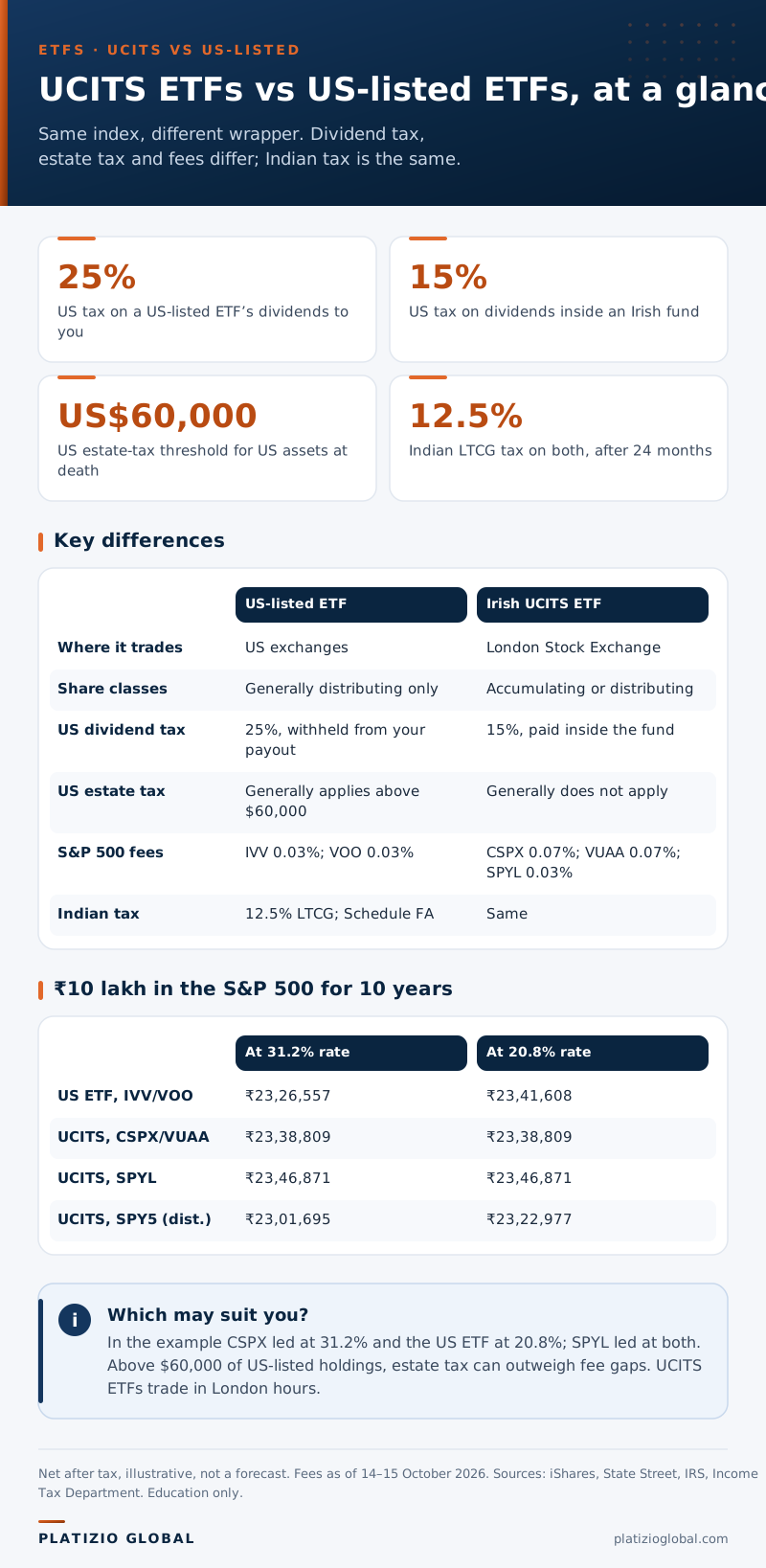
| US-listed ETF | Irish UCITS ETF | |
|---|---|---|
| Where it trades | US exchanges | LSE: 12:30–21:00 IST in UK summer, 13:30–22:00 in UK winter |
| Share classes | Generally distributing only | Accumulating or distributing |
| US tax on dividends | 25%, withheld from your payout | 15%, paid inside the fund |
| US estate tax | Generally applies above $60,000 | Generally does not apply |
| Indian tax and reporting | Long-term after 24 months; 12.5%; Schedule FA | Same |
Dividend withholding: 25% vs 15%
A US-listed ETF’s dividends to you suffer 25% US withholding under Article 10 of the India–US tax treaty, if you have filed Form W-8BEN (otherwise 30%). An Irish fund receives US dividends net of 15% under the US–Ireland treaty, and Ireland withholds nothing on payouts to non-residents.
At the S&P 500’s 1.10% trailing yield (IVV, 30 September 2026), withholding costs 0.275% of the portfolio a year in a US ETF and 0.165% in an Irish fund: about ₹1,100 a year apart on ₹10 lakh.
India taxes dividends you receive at your slab rate, with a foreign tax credit (FTC) capped at the Indian tax on that income.
- US ETF: at a 31.2% marginal rate (30% slab plus 4% cess), you pay the 6.2-point balance. At 20.8%, the excess US tax is lost, so 25% is your floor.
- Accumulating UCITS: nothing is paid out, and platforms describe Indian tax as deferred until you sell. We found no CBDT guidance on this, so confirm with a chartered accountant (CA).
- Distributing UCITS: the fund pays the 15%, so you generally cannot claim it as a credit; slab tax on the 85% paid out lifts the total to about 41.5% at 31.2%.
| Marginal rate | US ETF | Accumulating UCITS | Distributing UCITS |
|---|---|---|---|
| 31.2% | 0.343% | 0.165%, plus about 0.122% at sale | 0.457% |
| 20.8% | 0.275% | 0.165%, plus about 0.122% at sale | 0.359% |
Yearly dividend tax drag at a 1.10% yield.
At QQQ’s 0.42% trailing yield (October 2026), the Nasdaq-100 withholding gap is about 0.04 percentage point a year, below the UCITS fee premium of 0.12–0.15 point, so the UCITS case there rests on estate tax (see our Nasdaq-100 guide).
Do UCITS ETFs avoid US estate tax?
Generally, yes. The estate of a non-resident who is not a US citizen must file IRS Form 706-NA if US-situated assets exceed $60,000 at death. Stock of US corporations counts wherever it is held, even through a nominee, so US-listed ETFs held via GIFT City (India’s International Financial Services Centre) stay exposed. The IRS treats all other corporate stock as property outside the US, which generally covers Irish UCITS ETFs issued by Irish companies. India and the US have no estate tax treaty.
The tax runs from 18% to 40%, less a $13,000 credit: on $200,000, the IRS Table A tax of $54,800 falls to $41,800.
| US-situated assets at death | Tax after credit | At ₹95 per dollar |
|---|---|---|
| $100,000 | $10,800 | ₹10.26 lakh |
| $200,000 | $41,800 | ₹39.71 lakh |
| $500,000 | $142,800 | ₹1.36 crore |
Fees on popular UCITS and US ETF pairs
US-listed ETFs usually charge less. The total expense ratio (TER) is the annual fee deducted inside the fund.
| Index | US-listed ETF | Irish UCITS ETF |
|---|---|---|
| S&P 500 | IVV 0.03%; VOO 0.03% | CSPX (Acc) 0.07%; VUAA (Acc) 0.07%; SPYL (Acc) 0.03%; SPY5 (Dist) 0.03% |
| Nasdaq-100 | QQQ 0.18%; QQQM 0.15% | CNDX (Acc) 0.30%; EQQQ (Dist) 0.30% |
| Global shares | VT 0.06% | Vanguard FTSE All-World UCITS ETF (VWRA, Acc) 0.14% |
Fees from iShares and State Street (14 October 2026), stockanalysis.com (15 October 2026) and justETF (VUAA, SPY5, VWRA and EQQQ; 31 August 2026). Illustrative, not recommendations.
On ₹10 lakh, CSPX’s extra 0.04 percentage point costs about ₹400 a year; a one-off 0.20% worse exchange rate costs ₹2,000. As of October 2026, INDmoney charges 0.25% per UCITS trade and says banks charge 0.5–1.2% for currency conversion; Interactive Brokers charges 0.05% on UK trades (minimum $4 an order on dollar lines, fixed pricing).
How are UCITS and US ETFs taxed in India?
Both are foreign assets not listed in India, taxed alike in tax year 2026-27, the first year under the Income-tax Act, 2025:
- Capital gains: units held 24 months or less are short-term (section 2(101)), taxed at your slab rate. Long-term capital gains (LTCG) are taxed at 12.5% without indexation under section 197, plus cess. The ₹1.25 lakh exemption does not apply: section 198 needs securities transaction tax, which foreign trades do not pay.
- Dividends: slab rate, with credit for US tax withheld from you via Form 44 for tax year 2026-27 income; FY 2025-26 income still uses Form 67 under the 1961 Act.
- Reporting: both go in Schedule FA, the foreign-assets schedule of your tax return, for each calendar year held, even without a sale (Schedule FA penalties).
- Remittances: both use LRS (up to $250,000 a financial year). Tax collected at source (TCS) under section 394 is nil up to ₹10 lakh a year across all LRS remittances and 20% above, adjustable against your tax.
Worked example: ₹10 lakh in the S&P 500 for 10 years
Assumptions (illustrative, not a forecast): ₹10,00,000 invested once at ₹95 per dollar ($10,526.32), rate held constant; 10% a year before fees (8.90% price growth, 1.10% dividends); dividends taxed as above and reinvested yearly; sale after 10 years taxed at 13% (12.5% LTCG plus 4% cess); no brokerage or currency charges.
| Route (fee) | Net after tax, 31.2% rate | Net after tax, 20.8% rate |
|---|---|---|
| US ETF, IVV/VOO (0.03%) | ₹23,26,557 | ₹23,41,608 |
| Accumulating UCITS, CSPX/VUAA (0.07%) | ₹23,38,809 | ₹23,38,809 |
| Accumulating UCITS, SPYL (0.03%) | ₹23,46,871 | ₹23,46,871 |
| Distributing UCITS, SPY5 (0.03%) | ₹23,01,695 | ₹23,22,977 |
Reading one line: at 31.2%, the US ETF is worth ₹25,07,075 before sale; exit tax of ₹1,80,518 (13% of the gain over cost, including reinvested dividends) leaves ₹23,26,557.
- At 31.2%, CSPX/VUAA end ₹12,252 ahead (₹23,38,809 − ₹23,26,557).
- At 20.8%, the US ETF ends ₹2,799 ahead of them (₹23,41,608 − ₹23,38,809): the 25% US tax is a fixed cost, and its fee is lower.
- SPYL leads at both rates: by ₹20,314 at 31.2% and ₹5,263 at 20.8%.
- The distributing UCITS class trails at both rates.
These gaps are modest (0.3–2.0% of the amount invested); brokerage and currency costs can be as large. Estate tax can matter far more, though this US ETF holding stays under $27,000, below the $60,000 threshold.
How to buy UCITS ETFs from India
As of October 2026, residents can buy Irish UCITS ETFs in two main ways, both funded under LRS:
- INDmoney’s GIFT City service. INDmoney, a Global Access Provider authorised by GIFT City’s regulator, IFSCA, offers LSE-listed dollar accumulating classes, fractional from about $1, according to its site.
- An overseas broker such as Interactive Brokers, with direct LSE access.
More GIFT City apps and overseas brokers offer US-listed ETFs; compare them in our platforms guide. Platizio Global offers US-listed stocks and ETFs through ViewTrade International IFSC in GIFT City; it does not offer UCITS ETFs.
Which may suit you?
- Tax slab and fees: in the example, CSPX led at 31.2% and the US ETF at 20.8%; SPYL led at both.
- Holding size: above $60,000 of US-listed holdings, estate tax can outweigh fee differences.
- Income needs: distributing UCITS classes are usually the costliest for high-slab residents.
- Access: more platforms offer US-listed ETFs; UCITS ETFs trade in London hours.
On Platizio Global, US-listed ETFs such as VOO and QQQ can be bought in fractional amounts; brokerage is 0.29% per transaction (or $1 minimum) plus 18% IGST, as of October 2026.
Sources
- European Commission — Investment funds (UCITS Directive 2009/65/EC) — https://finance.ec.europa.eu/capital-markets-union-and-financial-markets/financial-markets/investment-funds_en
- IRS — India–US income tax treaty (Article 10, dividends) — https://www.irs.gov/pub/irs-trty/india.pdf
- IRS — US–Ireland income tax treaty (Article 10, dividends) — https://www.irs.gov/pub/irs-trty/ireland.pdf
- IRS — Instructions for Form 706-NA (Rev. 09/2025) — https://www.irs.gov/instructions/i706na
- IRS — Instructions for Form 706, Table A unified rate schedule (Rev. 07/2026) — https://www.irs.gov/instructions/i706
- Income Tax Department — Section 2, Income-tax Act, 2025 (holding periods) — https://www.incometaxindia.gov.in/w/section-2-263
- CBDT — FAQs on Form 44 and Form 45 — https://www.incometaxindia.gov.in/documents/d/guest/form-44-45-faqs
- Income Tax Department — Section 394, Income-tax Act, 2025 (TCS) — https://www.incometaxindia.gov.in/w/section-394-6
- Irish Funds — Irish ETFs one-pager (2025) — https://cdn.irishfunds.ie/x/c8518f7188/2025-etf-1-pager.pdf
- iShares — iShares Core S&P 500 ETF (IVV) — https://www.ishares.com/us/products/239726/ishares-core-sp-500-etf
- iShares — iShares Core S&P 500 UCITS ETF (CSPX) — https://www.ishares.com/uk/individual/en/products/253743/ishares-sp-500-b-ucits-etf-acc-fund
- INDmoney — UCITS ETFs (provider’s own product and pricing page) — https://www.indmoney.com/ucits
Platizio Global is operated by Platizio Services LLP, an AMFI-registered mutual fund distributor. Platizio is a referral partner, not a broker, investment adviser or research analyst. Accounts are opened and held with ViewTrade International IFSC Private Limited in GIFT City, which is regulated by the International Financial Services Centres Authority (IFSCA), and Platizio may receive remuneration from ViewTrade. Platizio Global offers US-listed stocks and ETFs only; it does not offer UCITS ETFs or other securities listed outside the US. This article is for education only and is not investment, tax or legal advice, or a recommendation to buy, sell or hold any security. The securities quoted are for illustration only and are not recommendatory. Investments in US stocks and ETFs are subject to market, currency, tax and regulatory risks; past performance is not indicative of future results, and returns are not guaranteed. Tax and regulatory figures are current as of 15 October 2026 and can change; consult a chartered accountant before acting.