Last updated: 19 October 2026 · By Analyst, Platizio Global
Resident Indians cannot use TreasuryDirect, which is open only to US persons. The practical route is a US-listed Treasury or bond exchange-traded fund (ETF), bought under the Liberalised Remittance Scheme (LRS) through a GIFT City app (India’s international financial centre) or an overseas broker. Indian funds of funds are an alternative; individual Treasuries may not be allowed under India’s foreign-exchange rules. A Treasury bill (T-bill) ETF yielding 3.74% (15 October 2026) keeps about 2.6% after 30%-slab tax, before costs, and a 3% rupee move outweighs that.
Key takeaways
- Treasury ETF payouts can be free of US tax, but a broker may still withhold 25%.
- India taxes payouts at slab and gains after 24 months at 12.5%, unless section 76 applies (unsettled).
- A 1 percentage point rise in long-term yields cuts TLT’s price by about 15%.
- US-listed ETFs face US estate tax above US$60,000; Treasuries held directly do not.
Can you buy US Treasury bonds directly from India?
Not through TreasuryDirect: you must certify “You are a U.S. person”, with “a valid U.S. Social Security Number”, “a U.S. address of record” and a US bank account.
Treasuries are also sold, from US$100, through “a bank, broker, or dealer”, including some overseas brokers. But under India’s Foreign Exchange Management Act (FEMA), LRS investments follow the Overseas Investment Rules, 2022, which bar portfolio investment in “any unlisted debt instruments”, including government bonds. Whether a Treasury counts as listed is unconfirmed; ask your bank or a chartered accountant (CA).
Ways to invest in US bonds from India, compared
| Route | Cost | US payout tax | Indian gains tax | US estate tax |
|---|---|---|---|---|
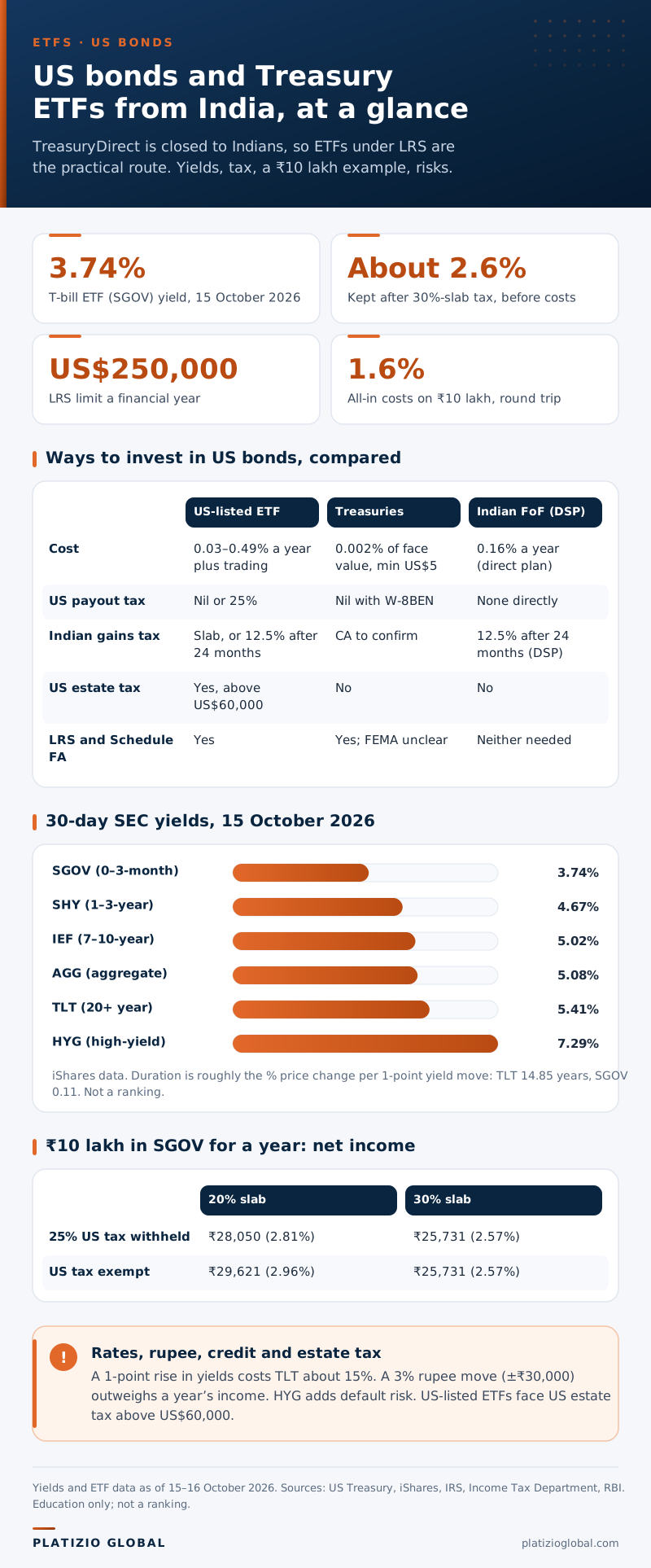
| US-listed ETF | 0.03–0.49% a year plus trading costs | Nil or 25% | Slab, or 12.5% after 24 months (unsettled) | Yes, above US$60,000 |
| Treasuries (overseas broker; FEMA unclear) | Interactive Brokers: 0.002% of face value, min US$5 | Nil with W-8BEN | CA to confirm | No |
| UCITS (EU-regulated) Treasury ETF | e.g. 0.07% a year (iShares IBTS, Irish) | None | As for US ETFs | Generally no |
| Indian fund of funds (DSP) | 0.16% a year (direct plan) | None directly | 12.5% after 24 months (DSP) | No |
Payouts are taxed at slab on all routes. The first three use LRS (US$250,000 a financial year) and go in Schedule FA; the Indian fund needs neither. October 2026; for illustration only.
US Treasury yields and bond ETFs in October 2026
Treasury yields on 16 October 2026: 4.26% (3 months), 5.09% (10 years), 5.43% (30 years). The Federal Reserve’s policy-rate range is 3.75–4.00%, after a 0.25-point rise on 16 September 2026.
| ETF (holdings) | Expense ratio | 30-day SEC yield | Duration (years) |
|---|---|---|---|
| SGOV (0–3-month Treasuries) | 0.09% | 3.74% | 0.11 |
| SHY (1–3-year Treasuries) | 0.15% | 4.67% | 1.81 |
| IEF (7–10-year Treasuries) | 0.15% | 5.02% | 6.85 |
| TLT (20+ year Treasuries) | 0.15% | 5.41% | 14.85 |
| AGG (US aggregate bonds) | 0.03% | 5.08% | 5.70 |
| HYG (high-yield company bonds) | 0.49% | 7.29% | 3.20 |
iShares data: SEC yields and effective duration 15 October 2026; expense ratios 19 October 2026. For illustration only; not a ranking.
SEC yields look back 30 days, so SGOV’s 3.74% trails the 4.26% 3-month bill. Duration is roughly the percentage price change per 1-point yield move.
Is US tax deducted on bond ETF payouts?
US fund payouts are dividends, so the India–US treaty caps US tax at 25% (Article 10, not the 15% on interest) with Form W-8BEN, which certifies non-US status; 30% without. But US law (Internal Revenue Code section 871(k)) exempts “interest-related dividends”, the part a fund reports as coming from US interest. iShares designated 100% of its 2026 payouts (February–October) on SGOV, SHY, IEF and TLT as exempt, against 82.9–93.8% for AGG, LQD and HYG.
US withholding rules say a broker “may” rely on these designations, so yours may still withhold 25%; recovering it needs a US return, Form 1040-NR. Interest on Treasuries held directly is exempt: as “portfolio interest” with a W-8BEN (section 871(h)), and on bills of 183 days or less (section 871(g)).
How India taxes US bonds and bond ETFs
- Payouts and coupons: slab rate on the gross amount, converted at SBI’s telegraphic transfer (TT) buying rate (Rule 206, old Rule 115). Credit for US tax is the lower of the two taxes, claimed on Form 44 from tax year 2026-27 (within 12 months of year-end) or Form 67 for FY 2025-26 (by 31 March 2027).
- ETF gains: slab within 24 months. After that, two views: 12.5% without indexation (section 197, old 112) plus surcharge and cess; or slab, if section 76 of the Income-tax Act, 2025 (old 50AA) applies, since it makes gains on units of “a Mutual Fund, by whatever name called” with over 65% in debt, bought from 1 April 2023, short-term. No CBDT circular or ruling settles this; ask a CA.
- Tax collected at source (TCS): banks collect 20% on LRS remittances beyond ₹10 lakh a financial year, credited against your tax (TCS on LRS).
- Schedule FA (foreign assets in your return): report every foreign holding each calendar year (Schedule FA rules).
Worked example: ₹10 lakh in a T-bill ETF for one year
₹10,00,000 at the RBI reference rate of ₹95.0194 (16 October 2026) buys US$10,524.17, or 104.62 SGOV units at US$100.59. Assume a year at the 3.74% SEC yield (₹37,400), flat price and rupee, and slab tax plus 4% cess (20.8% or 31.2%), surcharge ignored.
| Case | US tax | Indian tax after credit | Net income | Net yield |
|---|---|---|---|---|
| 20% slab, 25% withheld | ₹9,350 | ₹0 | ₹28,050 | 2.81% |
| 20% slab, exempt | ₹0 | ₹7,779 | ₹29,621 | 2.96% |
| 30% slab, 25% withheld | ₹9,350 | ₹2,319 | ₹25,731 | 2.57% |
| 30% slab, exempt | ₹0 | ₹11,669 | ₹25,731 | 2.57% |
At 30%, withholding costs nothing extra once you claim the credit; at 20%, ₹1,571 a year is lost without a US refund.
A 3% rupee move (±₹30,000) outweighs the year’s income; a currency loss offsets only capital gains.
Costs at a published GIFT City rate (0.29% brokerage, minimum US$1, 18% GST on it and a 0.005% regulator’s fee each way, plus US fees on sale) total US$73.32 round trip (0.70%, about ₹6,967). SBI’s TT rates on 16 October 2026 (₹95.40 to buy dollars, ₹94.55 to sell) add about ₹8,946; bank charges and markups vary. All-in, ₹15,912 (1.6%) cuts the 30%-slab ₹25,731 to ₹9,819.
Risks: rates, rupee, credit and estate tax
- Interest rates: a 1-point rise in yields costs TLT about 15% and SGOV about 0.11%. In the year to 16 October 2026 the 20-year yield rose 0.91 points; TLT’s price fell 12.4%, or 8.1% in dollars after payouts (Yahoo Finance, iShares).
- The rupee: the dollar’s 8.09% rise that year turned TLT’s −8.1% into −0.66% in rupees, and SGOV’s +3.70% into +12.09%; a stronger rupee works in reverse.
- Credit: corporate-bond ETFs such as HYG add default risk.
- US estate tax: US-listed ETFs are US-situs (US-located), even via a GIFT City nominee: above US$60,000 of US assets at death, tax runs from 18% to 40%, less a US$13,000 credit (US$10,800 on US$100,000). Treasuries held directly (US Code section 2105(b)) and Irish UCITS funds generally escape it (US estate tax).
Indian alternatives
Indian funds of funds need no LRS, TCS or Schedule FA. DSP US Specific Debt Passive FoF holds Irish iShares Treasury ETFs (₹52.1 crore, 30 September 2026); check it takes new money under SEBI’s overseas limits.
Sources
- U.S. Department of the Treasury: Daily Treasury Par Yield Curve Rates, 2026 — https://home.treasury.gov/resource-center/data-chart-center/interest-rates/TextView?type=daily_treasury_yield_curve&field_tdr_date_value=2026
- TreasuryDirect: User guide, opening an account (US-person certification) — https://www.treasurydirect.gov/indiv/help/treasurydirect-help/user-guide/001-010/
- Board of Governors of the Federal Reserve System: FOMC statement, 16 September 2026 — https://www.federalreserve.gov/newsevents/pressreleases/monetary20260916a.htm
- iShares: iShares 0-3 Month Treasury Bond ETF (SGOV); SHY, IEF, TLT, AGG and HYG from their sister pages, and the $ Treasury Bond 1-3yr UCITS ETF (IBTS) from iShares UK — https://www.ishares.com/us/products/314116/ishares-0-3-month-treasury-bond-etf
- iShares: 2026 monthly qualified interest income (QII) memo — https://www.ishares.com/us/literature/tax-information/2026-ishares-monthly-qii-memo-stamped.pdf
- IRS: United States–India Income Tax Convention — https://www.irs.gov/pub/irs-trty/india.pdf
- Legal Information Institute: 26 U.S. Code §871 (interest-related dividends; portfolio interest) — https://www.law.cornell.edu/uscode/text/26/871
- Legal Information Institute: 26 CFR §1.1441-3 (reliance on a fund’s designations) — https://www.law.cornell.edu/cfr/text/26/1.1441-3
- IRS: Instructions for Form 706-NA (US estate tax; situs of debt obligations) — https://www.irs.gov/instructions/i706na
- Income Tax Department: Section 76, Income-tax Act, 2025 — https://www.incometaxindia.gov.in/w/section-76-106
- Income Tax Department: FAQs on Form 44 and Form 45 — https://www.incometaxindia.gov.in/documents/d/guest/form-44-45-faqs
- Reserve Bank of India: Foreign Exchange Management (Overseas Investment) Rules, 2022 — https://www.rbi.org.in/Scripts/bs_viewcontent.aspx?Id=5087
Platizio Global is operated by Platizio Services LLP, an AMFI-registered mutual fund distributor. Accounts are opened and held with ViewTrade International IFSC Private Limited, which is regulated by the International Financial Services Centres Authority in GIFT City. Platizio is a referral partner, not a broker, investment adviser or research analyst, and may receive remuneration from ViewTrade. The worked example’s brokerage, GST and fee rates are those on Platizio Global’s pricing page (19 October 2026). This article is for education only. It is not investment, tax or legal advice, or a recommendation to buy, sell or hold any security. The securities quoted are for illustration only and are not recommendatory. Investments in US-listed ETFs, including bond ETFs, and in US bonds are subject to market, interest-rate, credit and currency risk and tax implications; past performance is not indicative of future results, and returns are not guaranteed. Prices, fees, tax rates and rules are as of 19 October 2026 and can change; check them with a chartered accountant before you act.