Last updated: 19 October 2026 · By Analyst, Platizio Global
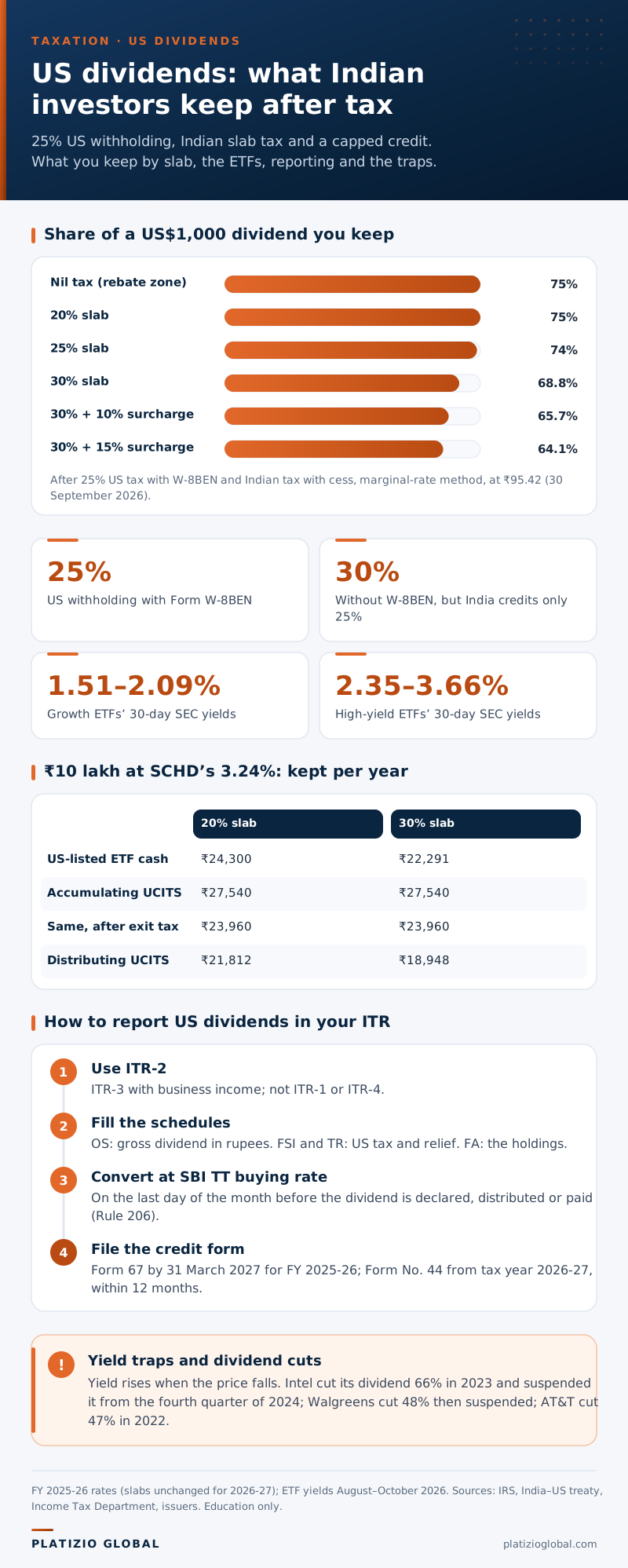
If you hold US dividend stocks or exchange-traded funds (ETFs) from India and have filed Form W-8BEN, the US withholds 25% of each dividend. India then taxes the gross dividend at your slab rate and credits the US tax only up to the Indian tax on it. You keep 75% if your rate is 20% or less (or the ₹12 lakh rebate makes your tax nil), 74% at the 25% slab, 68.8% at 30% and 64.1% at the top dividend surcharge, before costs and currency moves.
Key takeaways
- Without a valid W-8BEN, 30% is withheld, but India credits only 25%.
- Below the 25% slab, part of the US tax is never credited; if the rebate makes your tax nil, none of it is.
- Growth ETFs yielded 1.51–2.09% and high-yield ETFs 2.35–3.66% (30-day SEC yields, August–October 2026).
- File Form 67 by 31 March 2027 for FY 2025-26 dividends; from tax year 2026-27 the form is Form No. 44.
Dividend tax on US stocks in India: what you keep, by slab
Article 10 of the India–US tax treaty caps US tax on an Indian resident’s dividends, ETF payouts included, at 25% of the gross amount. That rate applies once you file Form W-8BEN, the IRS form certifying you are resident in India (how to fill in W-8BEN); without it, 30% is withheld. The 0%, 15% and 20% “qualified dividend” rates do not apply to non-residents.
India taxes the gross dividend at your slab rate plus 4% cess, and surcharge on higher incomes (capped at 15% on dividends). Under treaty Article 25 and Rule 76 of the Income-tax Rules, 2026, it credits the lower of the US tax (up to 25%) and the Indian tax on that dividend.
At the State Bank of India (SBI) telegraphic transfer (TT) buying rate of ₹95.42 (30 September 2026), a US$1,000 dividend paid in October 2026 is ₹95,420; US tax is ₹23,855. The table uses the common marginal-rate method; the average-rate method usually gives less credit.
| Rate with cess | Indian tax | Credit | Extra Indian tax | Total tax | You keep |
|---|---|---|---|---|---|
| Nil (income up to ₹12 lakh, new regime) | ₹0 | ₹0 | ₹0 | ₹23,855 (25%) | ₹71,565 (75%) |
| 20% slab (20.8%) | ₹19,847 | ₹19,847 | ₹0 | ₹23,855 (25%) | ₹71,565 (75%) |
| 25% slab (26%) | ₹24,809 | ₹23,855 | ₹954 | ₹24,809 (26%) | ₹70,611 (74%) |
| 30% slab (31.2%) | ₹29,771 | ₹23,855 | ₹5,916 | ₹29,771 (31.2%) | ₹65,649 (68.8%) |
| 30% + 10% surcharge (34.32%) | ₹32,748 | ₹23,855 | ₹8,893 | ₹32,748 (34.32%) | ₹62,672 (65.7%) |
| 30% + 15% surcharge (35.88%) | ₹34,237 | ₹23,855 | ₹10,382 | ₹34,237 (35.88%) | ₹61,183 (64.1%) |
Income Tax Department rates for FY 2025-26 (slabs unchanged for tax year 2026-27); surcharge 10% above ₹50 lakh of income, 15% above ₹1 crore.
- Full credit needs a rate of at least 25% with cess. At the 15% slab (15.6%), ₹8,969 of the US tax is lost.
- Rebate zone. The new regime’s rebate of up to ₹60,000 (section 87A; section 156 of the Income-tax Act, 2025) makes tax nil up to ₹12 lakh of income. At ₹11 lakh, tax of ₹50,000 falls to nil, so all ₹23,855 is lost.
- No W-8BEN. ₹28,626 (30%) is withheld but only ₹23,855 is credited, so at the 30% slab you pay ₹34,542 (36.2%). The extra ₹4,771 is lost unless the broker corrects the withholding or you file a US return (Form 1040-NR).
US dividend ETFs compared (October 2026)
Growth ETFs screen for years of rising dividends; high-yield ETFs for income now.
| ETF (issuer) | Type | Expense ratio | SEC yield | Trailing yield | Screen |
|---|---|---|---|---|---|
| DGRO (iShares) | Growth | 0.08% | 2.07% | 1.98% | 5+ years of growth; payout under 75% |
| NOBL (ProShares) | Growth | 0.35% | 2.09% | 2.01% | S&P 500, 25+ years of increases |
| VIG (Vanguard) | Growth | 0.04% | 1.51% | 1.51% | 10+ years of increases; top yielders excluded |
| DVY (iShares) | High yield | 0.38% | 3.66% | 3.51% | 100 highest yielders; coverage tests |
| HDV (iShares) | High yield | 0.08% | 3.51% | 3.05% | Quality and default-risk screens; pays monthly |
| SCHD (Schwab) | High yield | 0.06% | 3.23% | 3.24% | 10+ years of dividends; quality ranking |
| SDY (State Street) | High yield | 0.35% (gross) | 2.49% | 2.45% | Highest yielders with 20+ years of increases |
| VYM (Vanguard) | High yield | 0.04% | 2.35% | 2.29% | Above-average forecast yields |
Issuer pages (October 2026). Yields at 30 September 2026 (SCHD’s SEC yield and SDY’s at 15 October; NOBL’s at 31 August); VYM’s and VIG’s trailing yields use Vanguard’s last four distributions and 16 October closes. Grouped by type, then A–Z; for illustration, not a ranking.
The 30-day SEC yield, a US Securities and Exchange Commission (SEC) standard, annualises a fund’s last 30 days of income after expenses. SCHD, VYM and DVY exclude real estate investment trusts (REITs).
Example US dividend stocks (for illustration only)
Five long-time payers:
| Company (ticker) | Latest regular dividend | Yield at 16 Oct 2026 close | Record (company statement) |
|---|---|---|---|
| Coca-Cola (KO) | US$0.53 quarterly (raised Feb 2026) | 2.26% (US$93.90) | 64 consecutive annual increases |
| Johnson & Johnson (JNJ) | US$1.34 quarterly (raised Apr 2026) | 2.10% (US$255.56) | 64 consecutive years of increases |
| PepsiCo (PEP) | US$1.48 quarterly (from June 2026) | 4.50% (US$131.49) | 54 consecutive annual increases |
| Realty Income (O), a REIT | US$0.2715 monthly (Oct 2026) | 5.81% (US$56.08) | 676 consecutive monthly dividends (Oct 2026) |
| Verizon (VZ) | US$0.7075 quarterly (raised Jan 2026) | 6.32% (US$44.79) | 19 consecutive annual increases to 2025; raised again Jan 2026 |
Company filings on SEC EDGAR and Realty Income’s releases (8 September and 13 October 2026); closes from Yahoo Finance. Yield = annual regular dividend ÷ close.
REITs, MLPs and ADRs: the special tax cases
- REITs such as Realty Income. The 25% rate needs a stake under 10%, as retail holdings are, and a US-listed REIT’s capital-gain distributions to such holders count as ordinary dividends, not property gains withheld at 21%. India’s treatment of “return of capital” payouts is unsettled.
- MLPs (master limited partnerships, a kind of publicly traded partnership). Unitholders are partners in a US business and generally need a US tax return. Business-income distributions are withheld at 37%, and since 2023 brokers have generally withheld 10% of gross sale proceeds unless the partnership’s notice gives an exception.
- ADRs (American depositary receipts) of non-US companies. Their dividends are generally outside US withholding; the home country taxes them, and the depositary bank may deduct a custody fee.
Reinvesting dividends, and the accumulating UCITS alternative
INDmoney says most Indian platforms, itself included, currently credit dividends as cash rather than reinvesting them automatically; Groww credits them to your US account after withholding (both sites, 19 October 2026). Reinvesting is a new order: the dividend is still taxable in India in the year paid, each purchase starts its own 24-month clock, and a US$1 minimum fee is 5% of a US$20 purchase.
The Reserve Bank of India’s Liberalised Remittance Scheme (LRS) directions let you retain and reinvest investment income, but foreign exchange received or unspent, unless reinvested, must come home within 180 days. Since April 2023 these directions, not a 15-day limit, cover idle funds in residents’ foreign currency accounts in GIFT City (International Financial Services Centre). How the 180 days apply to uninvested dividend cash is not spelt out; ask a chartered accountant.
An Irish accumulating UCITS ETF (an EU-regulated fund that reinvests its income) loses 15% to US tax inside the fund, under the US–Ireland treaty, and pays nothing out. The table takes ₹10 lakh at SCHD’s 3.24% trailing yield (30 September 2026): ₹32,400 a year, with the same US dividends and no fees.
| Route, per year | 20% slab | 30% slab |
|---|---|---|
| US-listed ETF: cash after US and Indian tax | ₹24,300 | ₹22,291 |
| Accumulating UCITS: reinvested after the fund’s 15% | ₹27,540 | ₹27,540 |
| The same after 13% tax on a sale after more than 24 months | ₹23,960 | ₹23,960 |
| Distributing UCITS: cash after slab tax, no credit for the 15% | ₹21,812 | ₹18,948 |
At 30%, the accumulating fund ends about ₹1,669 a year ahead even after exit tax; at 20%, the US-listed ETF is ₹340 ahead. But it pays no income, and “no annual tax” is the common view, not a CBDT ruling; check with a chartered accountant. See UCITS vs US-listed ETFs for fees and estate tax.
How to report US dividends in your ITR
Use ITR-2 (ITR-3 with business income), not ITR-1 or ITR-4.
- Schedule OS: the gross dividend in rupees.
- Schedule FSI: for the United States, income, tax paid outside India, Indian tax on it, relief (the lower of the two) and treaty article.
- Schedule TR: total relief.
- Schedule FA: the holdings.
Convert each dividend at the SBI TT buying rate on the last day of the month before it is declared, distributed or paid (Rule 206; Rule 115 for FY 2025-26), and the US tax at the rate on the last day of the month before deduction (Rule 76; Rule 128 for FY 2025-26). The US tax statement, Form 1042-S, covers a calendar year.
Then file the credit form (how to file Form 67):
- FY 2025-26 income: Form 67 by 31 March 2027, if your return was filed on time or as a belated return.
- Tax year 2026-27 onwards: Form No. 44 within 12 months after the tax year ends (31 March 2028 for 2026-27), on the same condition. An accountant must verify it if foreign tax for the year is ₹1 lakh or more (about US$4,192 of gross dividends at ₹95.42).
Costs and other taxes to plan for
- TCS. Tax collected at source (TCS) on LRS remittances for investment is nil up to ₹10 lakh a financial year across all banks, then 20% of the excess, as banks apply section 394(1) of the 2025 Act: ₹1 lakh on ₹15 lakh. Claim it in your return, not in Form 67 or 44 (how to claim TCS credit).
- Brokerage and currency conversion vary by app. Apps offering US-listed stocks and ETFs through GIFT City include Groww, INDmoney and Platizio Global (their websites, 19 October 2026; compare platforms).
- Capital gains: long-term after more than 24 months, taxed at 12.5% (section 197) plus surcharge and cess, with no ₹1.25 lakh exemption; otherwise slab rate.
- Schedule FA. Report every foreign holding for each calendar year held, at any value. Since 1 October 2024, the ₹10 lakh Black Money Act penalty does not apply if foreign assets other than immovable property total ₹20 lakh or less (Schedule FA rules).
- US estate tax. US-listed shares and ETFs are US assets; non-residents get only US$60,000 free (a US$13,000 credit), with rates up to 40%.
Risks: yield traps, dividend cuts and currency
- Cuts. Intel cut its quarterly dividend from US$0.365 to US$0.125 in 2023 (66%) and suspended it from the fourth quarter of 2024. Walgreens cut 48% in January 2024, suspended its dividend in January 2025 and was delisted after a merger in August 2025. AT&T cut 47% in 2022.
- Yield traps. Yield is the dividend divided by the price, so it rises when the price falls.
- Concentration. DVY’s prospectus says a significant portion of its index was in financials and utilities (30 April 2026).
- Currency. A dollar fetched ₹94.55 on 16 October 2026 (SBI TT buying rate), 8.2% more than a year earlier (₹87.40), but fell from ₹96.35 to ₹94.45 between 8 and 17 October.
- Timing. Shares bought on or after the ex-dividend date, which the SEC says is usually the record date, miss the next payment.
Sources
- IRS: India–US income tax treaty (Articles 10 and 25) — https://www.irs.gov/pub/irs-trty/india.pdf
- IRS: Publication 515 (2026), Withholding of Tax on Nonresident Aliens and Foreign Entities — https://www.irs.gov/publications/p515
- IRS: Publication 519 (2025), U.S. Tax Guide for Aliens — https://www.irs.gov/publications/p519
- Income Tax Department: Individual tax rates, surcharge, cess and rebate (AY 2026-27) — https://www.incometax.gov.in/iec/foportal/help/individual-business-profession
- Income Tax Department: Rule 76, Income-tax Rules, 2026 (foreign tax credit) — https://www.incometaxindia.gov.in/w/rule-76-3
- Income Tax Department: Rule 206, Income-tax Rules, 2026 (exchange rate) — https://www.incometaxindia.gov.in/w/rule-206-1
- CBDT: FAQs on Form No. 44 and Form No. 45 — https://www.incometaxindia.gov.in/documents/d/guest/form-44-45-faqs
- Reserve Bank of India: Master Direction, Liberalised Remittance Scheme — https://rbi.org.in/Scripts/BS_ViewMasDirections.aspx?id=10192
- Reserve Bank of India: Remittances to IFSCs under the LRS, A.P. (DIR Series) Circular No. 03 (26 April 2023) — https://rbi.org.in/Scripts/BS_CircularIndexDisplay.aspx?Id=12494
- Schwab Asset Management: Schwab U.S. Dividend Equity ETF (SCHD) — https://www.schwabassetmanagement.com/products/schd
- Intel: Q2 2024 earnings release, dividend suspension (SEC EDGAR, 1 August 2024) — https://www.sec.gov/Archives/edgar/data/50863/000005086324000122/q224_earningsrelease.htm
- State Bank of India: daily TT buying rates (USD), as archived by sbi-fx-ratekeeper — https://github.com/sahilgupta/sbi-fx-ratekeeper
Platizio Global is operated by Platizio Services LLP, an AMFI-registered mutual fund distributor. Accounts are opened and held with ViewTrade International IFSC Private Limited, which is regulated by the International Financial Services Centres Authority in GIFT City. Platizio is a referral partner, not a broker, investment adviser or research analyst, and may receive remuneration from ViewTrade. This article is for education only. It is not investment, tax or legal advice, or a recommendation to buy, sell or hold any security. The stocks and ETFs quoted, and their yields, are for illustration only and are not recommendatory; dividends are not guaranteed and can be cut or suspended. Investments in US stocks and ETFs are subject to market risk, currency risk and tax implications; past performance is not indicative of future results, and returns are not guaranteed. Prices, fees, tax rates and rules are as of 19 October 2026 and can change; check them with a chartered accountant before you act.