Last updated: 15 October 2026 · By Analyst, Platizio Global
International mutual funds vs US stocks: neither is better for everyone. In October 2026 most Indian international funds are closed to new money under overseas investment caps, and some India-listed international exchange-traded funds traded at premiums above 20% in September. Direct US stocks are open but use the overseas remittance limit, with 20% tax collected at source above ₹10 lakh.
Key takeaways
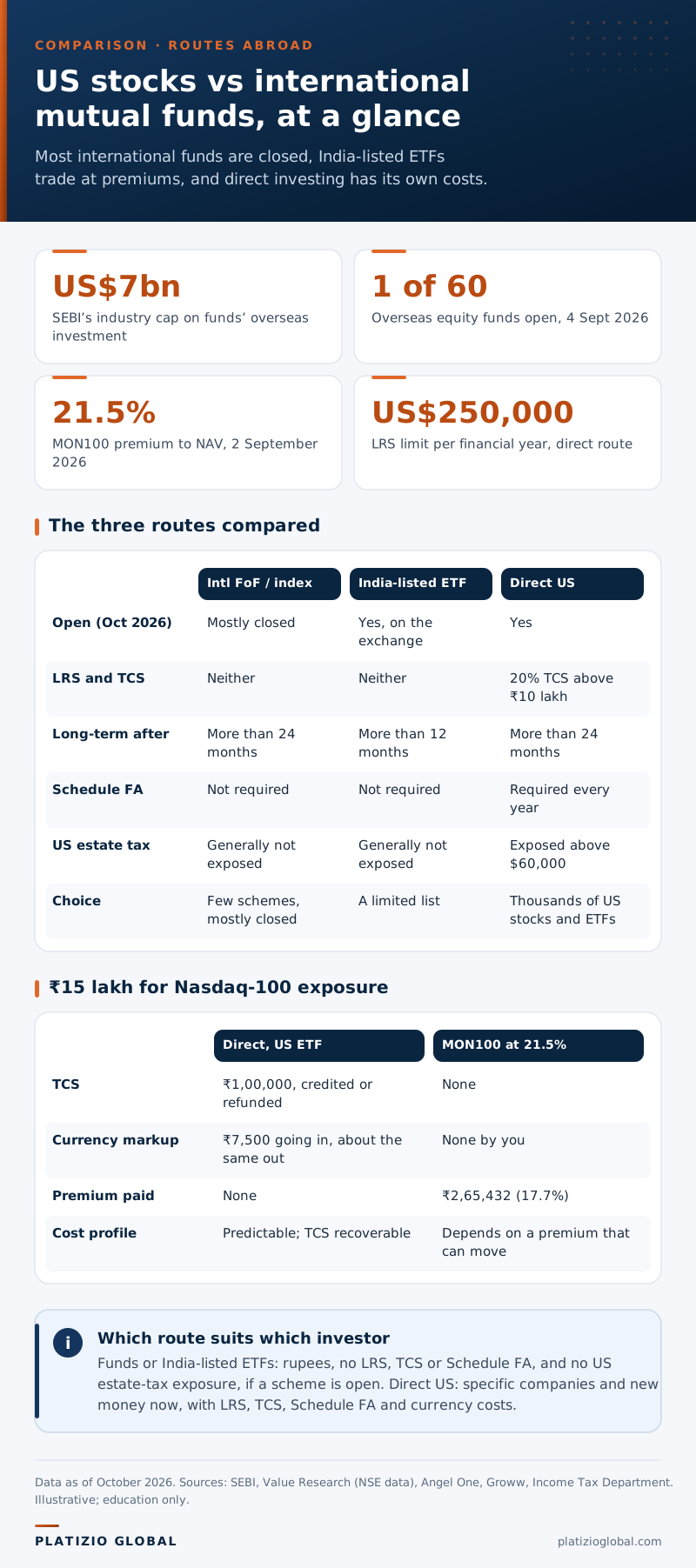
- The Securities and Exchange Board of India (SEBI) caps mutual funds’ overseas investment at US$7 billion industry-wide, plus $1 billion for overseas exchange-traded funds (ETFs), so funds keep closing to new money.
- On 4 September 2026 Value Research counted one of 60 overseas equity funds open to new investors; Angel One counted four on 20 August. Neither found an open Nasdaq-100 fund.
- The Motilal Oswal NASDAQ 100 ETF traded 21.5% above its net asset value (NAV) on 2 September 2026; if that premium vanishes, a buyer loses about 17.7%, whatever the index does.
- In tax year 2026-27, India-listed international ETFs turn long-term after more than 12 months, and international funds of funds and direct US shares after more than 24 months; all pay 12.5% on long-term gains.
- Direct US shares use the Liberalised Remittance Scheme (LRS), attract 20% tax collected at source (TCS) above ₹10 lakh, need foreign-asset reporting in Schedule FA, and can face US estate tax above $60,000.
International mutual funds vs US stocks: how each route works
International mutual funds are SEBI-regulated Indian schemes that invest abroad. You pay in rupees, and neither LRS nor TCS applies. They come in three forms:
- Fund of funds (FoF): invests in other funds or ETFs; most Nasdaq-100 FoFs hold Ireland-domiciled UCITS ETFs, and one holds QQQM.
- Index fund: holds the foreign shares itself; the ICICI Prudential NASDAQ 100 Index Fund holds 103 stocks.
- India-listed international ETF: trades on the stock exchange like a share, at a price that can differ from its NAV.
Direct investing means buying US-listed shares or ETFs yourself, through an app in GIFT City, home to India’s International Financial Services Centre, or through a US broker. Your rupees become dollars under LRS, which lets a resident send up to $250,000 per financial year. Our platform comparison covers fees.
Are international mutual funds open for investment in 2026?
Mostly not. SEBI’s circular of 3 June 2021 caps overseas investment at $7 billion for the industry and $1 billion per fund house, with a separate $1 billion industry limit ($300 million per fund house) for overseas ETFs. The industry reached the $7 billion ceiling in February 2022, and fund houses may invest only within the headroom they had on 1 February 2022. Recent changes:
- Invesco reopened three international FoFs on 8 May 2026 and suspended them again from 11 May, including existing systematic investment plan (SIP) instalments.
- In July 2026, Edelweiss, PGIM India and Franklin Templeton suspended fresh SIPs and lump sums in some international schemes.
- On 4 September 2026, Value Research found only Baroda BNP Paribas Aqua FoF open among 60 overseas equity funds; 34 closed funds still accepted existing SIPs and 25 had stopped them.
- On 20 August 2026, Angel One counted four open schemes, including three HSBC funds reopened on 18 August with investments capped at ₹2 lakh per permanent account number (PAN) a month.
- On 14 October 2026, Groww’s scheme pages showed all six Nasdaq-100 FoFs and the ICICI Prudential NASDAQ 100 Index Fund closed to new SIPs and lump sums. Motilal Oswal’s own notice had stopped new SIPs in its Nasdaq 100 FoF from 10 December 2024.
Check the fund house’s latest notice before you invest.
Why India-listed international ETFs trade at a premium
An ETF’s price usually tracks its indicative NAV (iNAV), the live value of its holdings, because market makers create new units when demand rises. The overseas caps stop new units being created, so prices can drift well above NAV. National Stock Exchange (NSE) data compiled by Value Research:
| ETF | Premium to NAV, 2 September 2026 |
|---|---|
| Motilal Oswal NASDAQ 100 ETF (MON100) | 21.5% (1-year average 10.8%; range −3.0% to 27.7%) |
| Motilal Oswal Nasdaq Q50 | 21.8% |
| Mirae Asset NYSE FANG+ | 21.1% |
In September 2026 Mirae Asset warned that the risk rose after a price-band rule from 7 September linked the band to the previous close, so a premium can go beyond the earlier 20% level. It advised comparing the price with iNAV before buying. A premium costs you only if it shrinks before you sell.
US stocks vs international funds compared
| International FoF or index fund | India-listed international ETF | Direct US stocks or ETFs | |
|---|---|---|---|
| How you pay | Rupees, to an Indian scheme | Rupees, on the stock exchange | Rupees converted to dollars under LRS |
| Open to new money (October 2026) | Mostly closed | Yes, by buying on the exchange | Yes |
| Minimum | Scheme minimum, if open | One unit (MON100: ₹328.83 on 2 September 2026) | From $1 on many apps (fractional shares) |
| SIP | Only if the scheme accepts SIPs | No fund SIP | Depends on the platform |
| LRS and TCS | Neither | Neither | $250,000 per financial year; 20% TCS above ₹10 lakh |
| Costs | Fund fee; FoFs add the underlying fund’s fee | Fund fee, plus any premium paid | Brokerage and currency markup each way, plus ETF fees |
| What you own | Units of an Indian scheme | Units of an Indian ETF | US shares or ETF units, via a US broker or GIFT City nominee |
| Currency of holding | Rupee units | Rupee units | Dollars |
| Long-term after | More than 24 months | More than 12 months | More than 24 months |
| Schedule FA | Not required | Not required | Required every year |
| US estate tax | Generally not exposed | Generally not exposed | Exposed above $60,000 |
| Choice | Few schemes, mostly closed | A limited list | Thousands of US stocks and ETFs |
How each route is taxed in tax year 2026-27
The Income-tax Act, 2025 applies from 1 April 2026 and replaces “previous year” and “assessment year” with “tax year”. For residents in tax year 2026-27:
- Direct US shares and ETFs: long-term after more than 24 months, taxed at 12.5% without indexation under section 197, plus surcharge and cess; short-term gains at your slab rate. The ₹1.25 lakh exemption does not apply, because section 198 requires securities transaction tax. Dividends are taxed at slab rates; the US withholds 25%, the India–US treaty rate, instead of 30% once you file Form W-8BEN, and Form 44 claims credit up to the Indian tax on that dividend.
- International funds of funds: long-term after more than 24 months at 12.5%; short-term at slab rates.
- India-listed international ETFs: long-term after more than 12 months at 12.5%; short-term at slab rates. Neither these ETFs nor international FoFs count as equity-oriented, so neither gets the ₹1.25 lakh exemption.
- TCS: section 394 applies only to the direct route’s remittances, and the amount collected is credited against your tax or refunded.
Gains and dividends from financial year (FY) 2025-26 go in the return for assessment year 2026-27 under the Income-tax Act, 1961, where the 12.5% rate sits in section 112, TCS in section 206C(1G) and the credit claim in Form 67. More in tax on US stocks bought through GIFT City and Schedule FA penalties.
Worked example: ₹15 lakh through each route
Assumptions: a resident with no other LRS remittance in FY 2026-27 invests ₹15,00,000 for Nasdaq-100 exposure, as an illustration only. The bank’s currency markup is 0.5% each way. MON100 trades at its 2 September 2026 premium of 21.5%. Fund fees, brokerage and returns are ignored.
Direct, through a US-listed ETF:
- TCS: 20% × (₹15,00,000 − ₹10,00,000) = ₹1,00,000, paid when you remit and credited against your tax or refunded after you file your return.
- Currency markup: 0.5% × ₹15,00,000 = ₹7,500 going in, and about the same coming back.
Rupee route, through MON100 (Nasdaq-100 FoFs are closed to new money):
- No LRS, no TCS and no currency conversion by you.
- ₹15,00,000 ÷ 1.215 = ₹12,34,568 of NAV, so ₹2,65,432 (17.7%) is premium.
- If the premium falls to zero by the time you sell, that ₹2,65,432 is lost whatever the index does; if it persists, nothing is lost to it.
The direct route’s costs are predictable, and its largest item, TCS, is recoverable. The ETF route’s cost depends on a premium that can move either way.
Which route suits which investor
International funds or India-listed ETFs may suit you if you want to invest in rupees without LRS, TCS or Schedule FA, prefer an index to individual stocks, and want to avoid US estate-tax exposure. Check that the scheme is accepting money, expect that even existing SIPs can be stopped, and compare an ETF’s price with its iNAV.
Direct US stocks or ETFs may suit you if you want specific companies or US-listed ETFs, want to invest new money now, and can handle LRS paperwork, TCS cash flow, Schedule FA and currency costs. US estate tax applies above $60,000 of US assets at death; Ireland-domiciled UCITS ETFs, which follow EU fund rules, are generally outside it.
Platizio Global, which publishes this guide, offers US-listed stocks and ETFs through ViewTrade International IFSC in GIFT City.
Sources
- Reserve Bank of India — Master Direction, Liberalised Remittance Scheme (updated 6 September 2024)
- Income Tax Department — Section 2, Income-tax Act, 2025 (short-term capital asset)
- Income Tax Department — Section 197, Income-tax Act, 2025
- Income Tax Department — Section 394, Income-tax Act, 2025
- CBDT — FAQs on Form 44 and Form 45
- IRS — Some nonresidents with US assets must file estate tax returns
- Motilal Oswal Mutual Fund — Addendum on SIPs in the Nasdaq 100 FoF (5 December 2024)
- ICICI Prudential AMC — Tax Reckoner 2026-27
- SCC Online — SEBI overseas investment limits for mutual funds (circular of 3 June 2021)
- Value Research — International funds open for investment, September 2026
- Cafemutual — Mirae Asset warns investors about overseas ETFs (11 September 2026)
- Business Today — Why mutual funds are stopping international SIPs (18 July 2026)
This guide is for education only. It is not investment, tax or legal advice, and the funds and securities named are for illustration only, not recommendations. Platizio Global is operated by Platizio Services LLP, an AMFI-registered mutual fund distributor. Platizio is not a broker or investment adviser; its US-stock accounts are opened and held with ViewTrade International IFSC Private Limited, an IFSCA-regulated intermediary in GIFT City, and Platizio may receive remuneration from ViewTrade as its referral partner. Investments carry market, currency, tax and regulatory risks, past performance does not indicate future results, and returns are not guaranteed. Fund status, rules and tax rates are as of 15 October 2026 and can change; read all scheme documents and consult a qualified tax adviser before investing.